Tsunami Advisory Issued for Guam and Mariana Islands
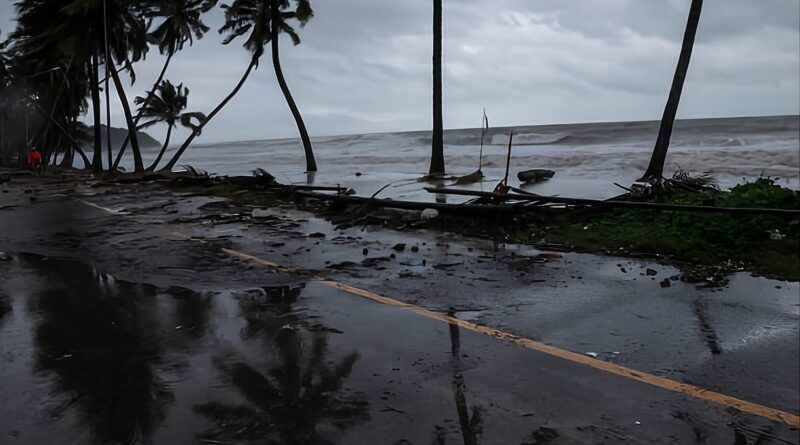
The Pacific Tsunami Warning Center (PTWC) issued a tsunami advisory for Guam and the Commonwealth of the Northern Mariana Islands on Monday, June 8, 2026, following a powerful earthquake near the southern Philippines. Residents and visitors in the Marianas have been instructed to stay out of the water and clear all public beaches. The earliest hazardous sea-level fluctuations and strong ocean currents are projected to arrive in the region around 12:45 PM ChST.
Seismic Event and Magnitude Readings
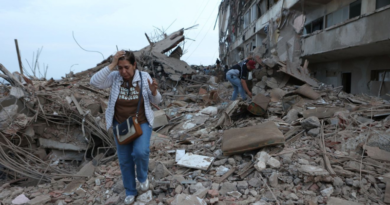
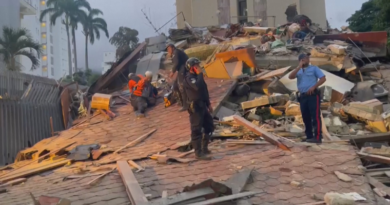
A powerful earthquake struck off the coast of Sarangani, Mindanao, in the southern Philippines, triggering immediate regional alarms. Automated seismic networks, including GlobalQuake, initially estimated the massive event at a magnitude of 8.6 to 9.0. However, official global geological agencies subsequently adjusted and stabilized the preliminary readings.
Current preliminary estimates of the earthquake’s strength range from 7.0 to 8.2. Official geological agencies have stabilized the reading around 7.0 to 7.4, while some international monitors, including the German Research Centre for Geosciences (GFZ), measured the quake as high as magnitude 8.2 at a shallow depth of 10 kilometers. Despite the variance in early calculations, the seismic energy released was sufficient to prompt widespread maritime alerts across the western Pacific.
Tsunami Threat and Estimated Arrival Times
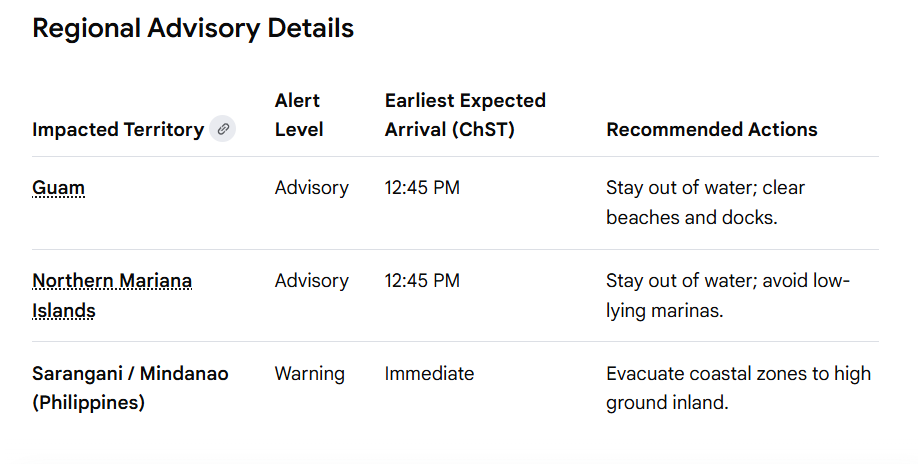
Following the earthquake, the Pacific Tsunami Warning Center issued a formal tsunami advisory for Guam and the Northern Mariana Islands, which includes Saipan, Tinian, and Rota. The PTWC noted that the primary risk to these territories involves significant sea-level fluctuations and strong, dangerous ocean currents. The earliest estimated arrival time for these hazardous marine disruptions in the Marianas is 12:45 PM ChST on Monday, June 8, 2026.
Unlike a tsunami warning, a tsunami advisory indicates that widespread, catastrophic land inundation is not expected in the Marianas. However, the incoming seismic energy is capable of producing violent, unpredictable currents that pose an immediate threat to swimmers, divers, and small boats. Because a tsunami acts as a series of successive waves rather than a single event, these dangerous conditions are expected to continue for several hours after the first wave arrives.
Immediate Safety and Evacuation Guidelines
Guam Homeland Security and the Office of Civil Defense have issued immediate safety directives for the public. All individuals are instructed to stay out of the ocean water and immediately vacate beaches, active harbors, docks, and low-lying marinas. Public safety officials emphasize that even minor sea-level changes can generate currents strong enough to sweep people off docks or drag swimmers out to sea.
For vessels, officials recommend that boat owners in harbors and shallow estuaries secure their crafts and remain away from the waterfront. Boats already operating in deep open water are advised to stay in deep water until the advisory is officially lifted. Shoreline spectators are warned not to approach the coast to observe the wave arrivals, as the marine conditions can deteriorate rapidly without warning.
Regional Advisory Breakdown
While the Mariana Islands remain under a tsunami advisory, a more severe tsunami warning is active for coastal zones in the Philippines, particularly in the Mindanao and Sarangani regions. Philippine emergency agencies have ordered immediate evacuations for residents in coastal zones, urging them to move to higher ground or further inland. Agencies in neighboring western Pacific territories, including Indonesia, Palau, Yap, and Taiwan, are also actively monitoring sea levels.
Local authorities in Guam and the Northern Mariana Islands are working closely with the National Weather Service (NWS) Guam to track the wave progression. Emergency management officials advise all residents to monitor localized emergency broadcasts, NOAA Weather Radio, and updates from civil defense offices. The advisory will remain in effect until official real-time monitoring confirms that the coastal current hazards have fully subsided.