Trump Claims UK Prime Minister Starmer Will Resign
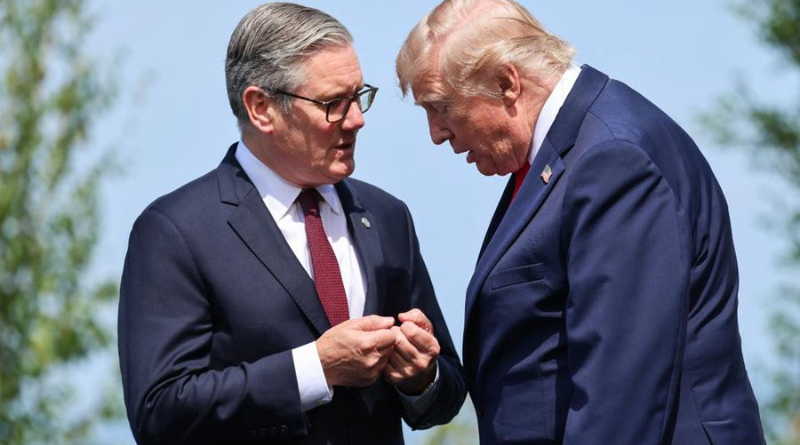
US President Donald Trump claimed on Sunday, June 21, 2026, that British Prime Minister Keir Starmer “will resign” amid an escalating leadership crisis in the United Kingdom. Trump posted his remarks on Truth Social as major British news outlets reported that Starmer could announce a timeline for his departure as soon as Monday, June 22. The statement adds international pressure to a growing rebellion within Starmer’s own Labour Party.
Trump’s Statements on Truth Social
In his Sunday morning post, President Trump declared that the British Prime Minister would soon step down from office. Trump asserted that Starmer’s impending departure is the result of failing badly on two very important subjects, specifically immigration and energy. The US President also reiterated his ongoing demand for the UK to reopen North Sea oil drilling to boost its energy independence.
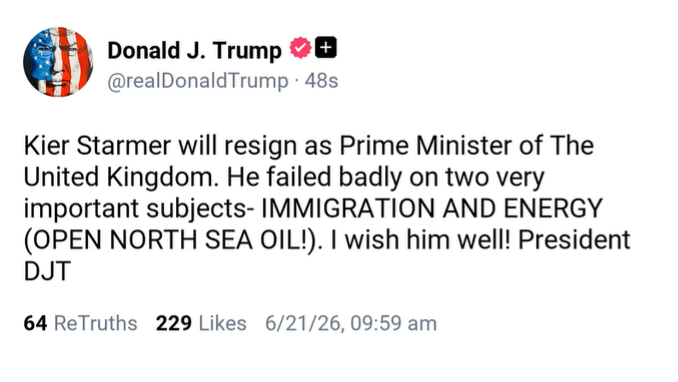
While Trump concluded his online post by wishing Starmer well, his comments have amplified the intense political pressure already mounting in London. It remains unclear whether the US administration possesses explicit inside information regarding Starmer’s plans. Observers note that the president’s remarks heavily align with widely synchronized reports currently circulating across the British media.
The Escalating UK Leadership Crisis
The political crisis surrounding Starmer has intensified over the weekend, with multiple major UK outlets reporting that the Prime Minister is actively reflecting on political realities. High-level sources suggest that Starmer is preparing to announce a definitive timetable for his departure on Monday. This potential announcement follows months of declining poll numbers and growing dissatisfaction with his administration’s domestic policies.
The internal mutiny within the Labour Party has reached a critical threshold, with over 100 Members of Parliament reportedly demanding his resignation. Additionally, at least four senior cabinet ministers have reportedly told Starmer that he must step aside for the good of the party. Among those calling for his departure are Foreign Secretary Yvette Cooper and Home Secretary Shabana Mahmood, signaling a profound division at the highest levels of the British government.
Downing Street and Official Responses
In response to the mounting speculation, a Downing Street spokesperson pointed to Starmer’s remarks on Friday, emphasizing that he remains focused on serving his country. Number 10 officials have sought to downplay the reports of an imminent resignation, maintaining that the government continues to function normally. Furthermore, Downing Street confirmed to the BBC that Starmer has not had any direct communication with President Trump over the weekend.
The lack of communication suggests that Trump’s social media post was not prompted by a direct briefing from the British government. Diplomatic experts suggest that the public intervention by a sitting US president in the internal leadership dynamics of a close ally is highly unusual. The comments have nevertheless fueled the ongoing political debate in both Washington and London regarding the future of the UK’s leadership.
Potential Successors and Political Fallout
The internal rebellion within the Labour Party escalated dramatically following Friday’s Makerfield by-election. Former Greater Manchester Mayor Andy Burnham won a seat in Parliament during the special election, immediately shifting the party’s internal power dynamics. Following his victory, Burnham quickly emerged as the overwhelming favorite among Labour MPs to replace Starmer as the party leader and Prime Minister.
The rapid consolidation of support behind Burnham has left Starmer with increasingly limited options to preserve his leadership. Party insiders indicate that the transition planning is already underway, as senior figures attempt to avoid a prolonged and damaging leadership contest. The coming days will determine whether Starmer can negotiate an orderly transition or if he will face a formal challenge from his own cabinet.
Geopolitical Implications of a Transition
A sudden change in the United Kingdom’s leadership could have broad implications for international relations, particularly concerning the US-UK special relationship. Under Starmer’s leadership, London and Washington have maintained close cooperation on global security and trade, despite occasional public disagreements. A transition to a new Prime Minister, especially one backed by different factions within the Labour Party, could lead to shifts in the UK’s foreign policy approach.
Furthermore, the domestic debate over energy policies, highlighted by President Trump’s comments, remains a sensitive topic across Europe. The UK’s decisions regarding North Sea drilling and green transition initiatives are closely watched by international markets. A new administration in Downing Street would face immediate pressure to address these complex economic and environmental challenges while maintaining international alliances.