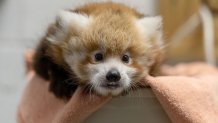
The National Zoo has a new red panda. You can help choose her name
She may only old 4 months old, but she is bold and feisty — and she needs a name to match.
Three red panda cubs were born at the Smithsonian Conservation Biology Institute campus in Front Royal, Virginia, earlier this year. Now, animal lovers can vote on the name for one of those cubs, born to 3 year old female Keahi and 7 year old Rocket.
Smithsonian/Brooke McDonough
Smithsonian/Brooke McDonough The initial veterinary exam of a juvenile female red panda cub in Front Royal, Virginia. She is currently unnamed, but is the offspring of Keahi (dam) and Rocket (sire), born on June 11, 2026. In this photo she is being weighed while in a plastic bucket.
The National Zoo has picked three possible names for her, and needs need help choosing one:
- Dolly – inspired by country music legend, Dolly Parton
- Pyra – meaning “heat” in Greek
- Dolpa – a region of Nepal that is home to wild red pandas
Voting can be done through the link here.
The new cub was one of three new cubs born this summer and arrived June 11. The two other cubs were a male and female born to 3- year-old Sequoia and 12-year-old Mow Mow on May 19.
According to the National Zoo, red panda cubs often struggle in their early days and have low survival rates. Zookeepers account for it by putting in a little extra work to keep an eye on the babies and their moms.
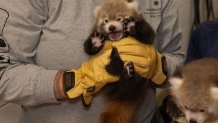
Jessica Kordell holding a male red panda cub during a routine exam. The cub was born on May 30, 2026 to parents Sequoia and Mow Mow. Smithsonian/Roshan Patel
“Having both dams being relatively inexperienced moms, we knew going into it there could be challenges,” said Jessica Kordell, assistant curator of carnivores, in a press release from over the summer. “This year, we moved the pandas into their air-conditioned, indoor spaces before we had too many hot days. Keeping their natural behaviors in mind, we also elevated the nest boxes off the ground, in hopes of reducing stress on the dams.”
When they were born, the cubs were “really just balls of fur that eat and sleep,” Kordell said. But as they’ve grown, the cub the public will help name “has distinguished herself with bold and feisty behavior,” the zoo said.