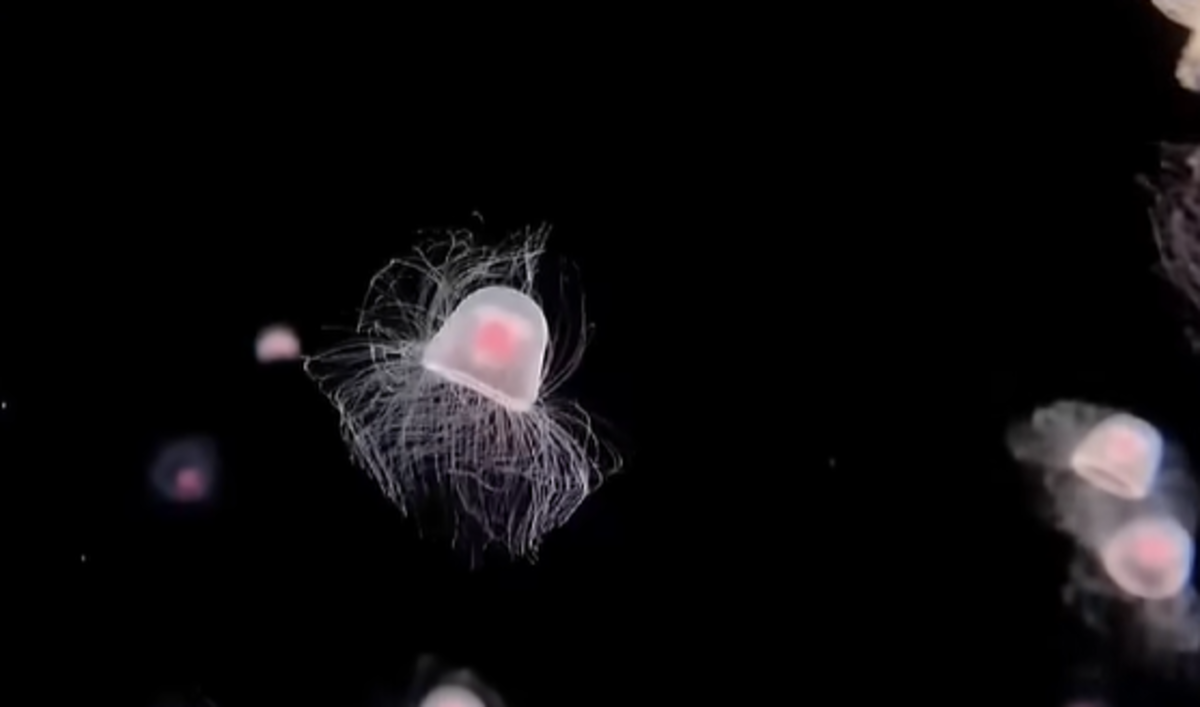
Scientists Look to ‘Immortal’ Jellyfish for Secrets to Reversing Human Aging
The “immortal” jellyfish is the only known animal capable of reversing its development and returning to a juvenile state after reaching sexual maturity. Researchers around the world are actively studying the genome of this species, scientifically known as Turritopsis dohrnii. Their objective is to identify the molecular pathways responsible for this transformation. They hope these findings may eventually contribute to human cellular rejuvenation.
What Is the ‘Immortal’ Jellyfish?
It is only about 4.5 millimeters wide and is characterized by a translucent, bell-shaped body. It is technically a hydrozoan. Originally native to the Mediterranean Sea, the species is now found in temperate and tropical coastal waters globally.
Similar to other hydrozoans, it begins as a swimming larva called a planula. This larva settles onto the seafloor and develops into a branching colony of plant-like structures called polyps. These polyps eventually transform into free-swimming, bell-shaped adults called medusae.
In other jellyfish species, the medusa reproduces sexually and dies. However, when an adult immortal jellyfish encounters adverse conditions, it can follow an alternative developmental pathway. It drops to the ocean floor and shrinks into a cyst. It then transforms directly back into a polyp colony. From that newly formed polyp colony, hundreds of genetically identical jellyfish can emerge.
Genome Mapping
Researchers mapped the genome of Turritopsis dohrnii and “compared it with the genome of Turritopsis rubra (a related jellyfish species that lacks the same rejuvenation ability). They found that the immortal jellyfish has twice as many copies of genes associated with DNA repair and protection.
As humans age, the protective caps at the ends of our chromosomes shorten and drive cellular death. By contrast, the immortal jellyfish possesses a unique genetic mutation that prevents telomere degradation. This keeps the chromosomal caps fully maintained.
Scientists note that T. dohrnii’s molecular switches have potential applications in regenerative medicine and health span extension. If we identify the genetic pathways that could safely trigger trans differentiation, doctors could potentially stimulate a patient’s own tissue to regenerate.