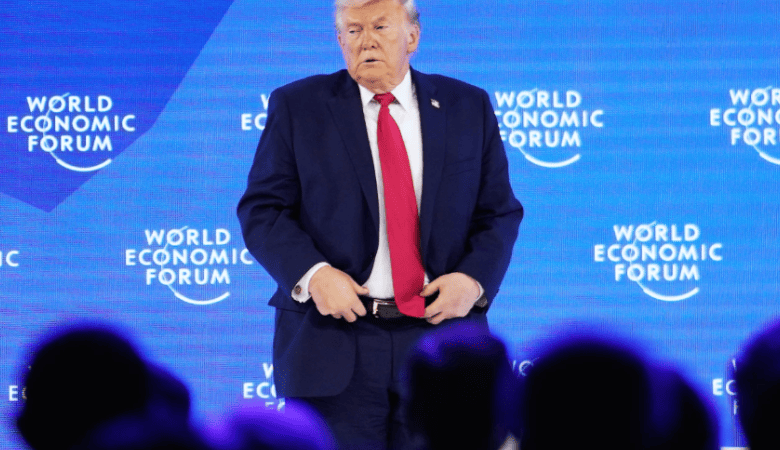
President Donald Trump addressed the World Economic Forum in Davos, Switzerland, on Wednesday. He used the global platform to clarify his administration’s stance on Arctic expansion. During the speech, the President officially ruled out the use of military force. However, he firmly reiterated the Greenland purchase demand that has sparked tensions across Europe.
President Addresses World Leaders in Switzerland
President Trump took the stage in Davos earlier today. His speech covered various topics, from economic growth to international trade. Yet, the primary focus quickly shifted to the Arctic. The President described the acquisition of Greenland as a vital strategic move for United States national security.[2] He dismissed recent reports suggesting a military escalation.
“We are looking at a deal, a real estate deal,” the President stated. “We will not use force. That is fake news. But the United States maintains a serious interest in this purchase.”
This clarification comes after weeks of speculation. Several European outlets had reported troop movements near the North Atlantic. The President’s speech aimed to calm these specific fears. He emphasized peaceful negotiation over conflict. Nevertheless, he made it clear that the topic remains on the table.
The audience in Davos reacted with visible murmurs. Many attendees expected the President to drop the issue entirely. Instead, he doubled down on the proposal. He cited the vast natural resources available in the region. He also noted the strategic importance of the island for monitoring global shipping lanes.
Diplomatic Fallout and Greenland Purchase Demand Reactions
European leaders responded swiftly to the address. The Greenland purchase demand continues to strain relationships between Washington and its transatlantic partners. Following the speech, the European Parliament announced a pause on the ratification of a pending US-EU trade deal. This suspension serves as a direct diplomatic protest.
Danish officials also voiced their strong opposition. A leading Member of the Danish Parliament called the President’s logic “very flawed.” The Danish Foreign Minister urged the United States to abandon the plan immediately. They reiterated that Greenland is not for sale.
“We are open for business, but we are not for sale,” the Foreign Minister posted on social media. “This conversation must end.”
NATO Secretary-General Mark Rutte held an emergency call with President Trump shortly after the speech. Sources indicate the conversation was tense but professional. The alliance seeks to prevent any further division among its members. Canada has also expressed concern. Ottawa fears that the Greenland purchase demand could destabilize the Arctic Council’s cooperative environment.
Economic Implications and Strategic Resources
The United States interest in Greenland is not new. However, the intensity of the current pursuit is unprecedented. Analysts point to the island’s rare earth mineral deposits as a key motivator. These minerals are essential for modern technology, including batteries and defense systems.
Currently, China dominates the market for these resources. By acquiring Greenland, the United States could secure a domestic supply chain. This would reduce reliance on foreign competitors. The President alluded to this economic benefit multiple times. He argued that the purchase would stabilize global markets.
Furthermore, the melting ice sheets have opened new shipping routes. Control over these routes offers immense economic power. The administration views the island as an unsinkable aircraft carrier in the North Atlantic. This perspective drives the persistent Greenland purchase demand despite international pushback.
Economic experts at Davos offered mixed reactions. Some see the potential for massive investment in the region. Others warn of the astronomical costs associated with such a purchase. The financial burden of maintaining the island’s infrastructure would be significant.
Security Updates: ISIS Detainee Transfer
While the Arctic issue dominated headlines, other major security news emerged from the summit. US officials confirmed a new operation regarding detainees in the Middle East.The US military will move up to 7,000 ISIS detainees from Syria to Iraq.
This decision follows a recent jailbreak attempt in Syria. Syrian government forces have advanced into areas previously held by US partners. This advance threatened the security of the detention centers. The transfer aims to prevent a resurgence of the terror group.
“We are taking proactive steps,” a White House official stated. “We cannot allow these fighters to return to the battlefield.”
The movement of detainees adds another layer of complexity to US foreign policy. It demonstrates that the administration is managing multiple high-stakes situations simultaneously. Critics argue that the focus on Greenland distracts from these urgent threats. Supporters believe the President is capable of handling both issues.
Future of the Arctic Dialogue
The coming days will be critical for US-European relations. The suspension of the trade deal is a significant blow. Business leaders hope for a quick resolution. However, the President shows no signs of retracting the Greenland purchase demand.
Diplomats will likely continue discussions behind closed doors. The goal is to find a face-saving solution for all parties. For now, the Arctic remains a flashpoint in global politics. The world watches to see if this real estate ambition becomes a reality or remains a diplomatic dispute.
The World Economic Forum continues through the week. More reactions are expected as other world leaders take the podium. WFB News will continue to monitor the situation closely. We will provide updates on the trade deal status and any further comments from the White House.