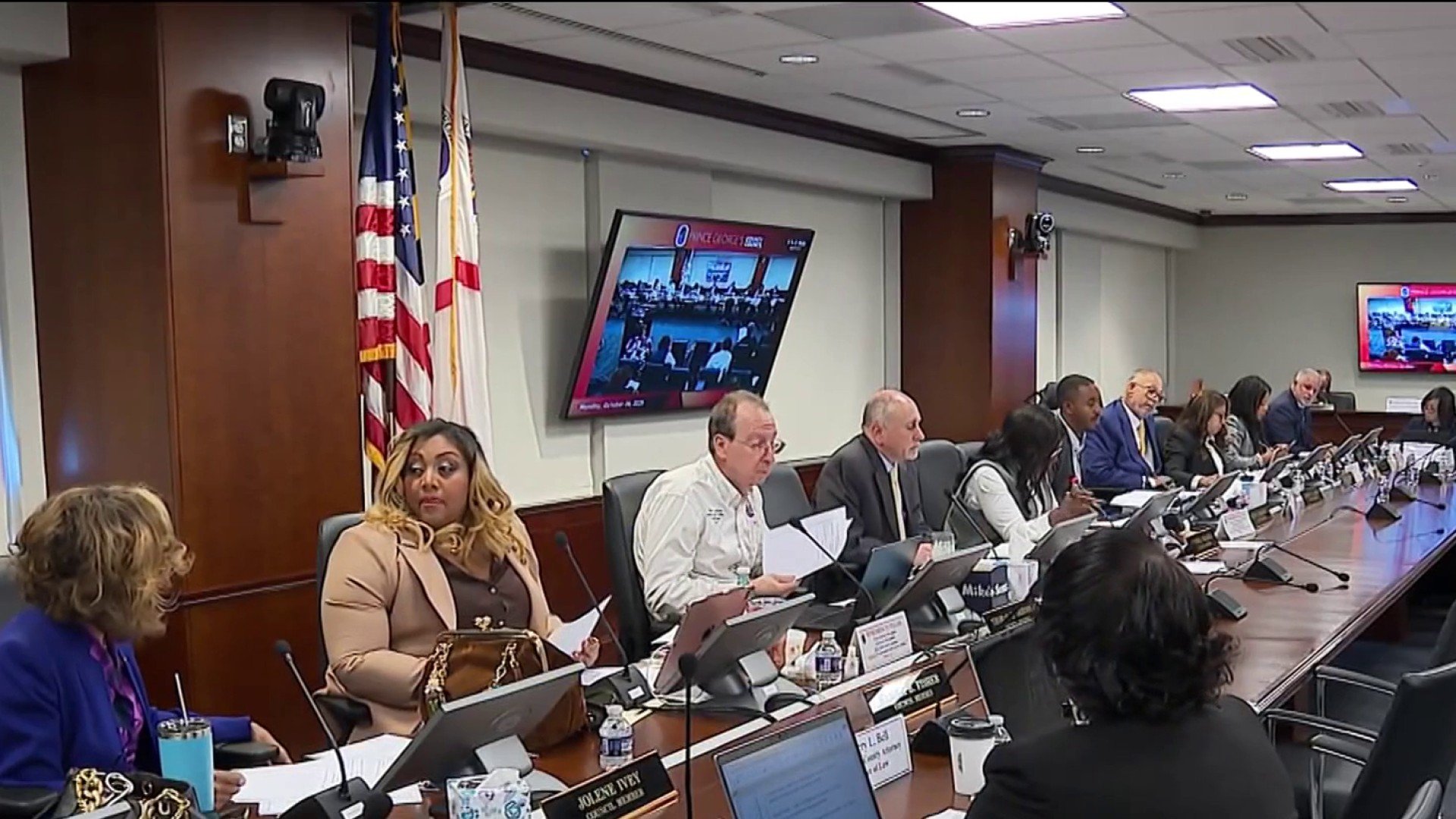
Prince George’s County cracks down on illegal street vending
The Prince George’s County Council passed a bill Monday to crack down on illegal vending.
Those who repeatedly break the rules could be hit with thousands of dollars in fines.
In some parts of Prince George’s County, like Langley Park, it’s not uncommon to find street vendors selling food and drinks. It’s how some make ends meet, and some vendors and members of the immigrant community say they’re being unfairly targeted.
But critics say some of these activities are creating hazards, and they want rules to keep everyone safe.
Supporters and opponents spoke at a public hearing.
“There are people selling food and drinks out of coolers in their yards, on street corners, on the sidewalk,” one supporter said at the hearing. “This is occurring during the week and also on weekends. Safety is obviously a concern for the people who are doing this and also for those who are affected by this.”
Prince George’s County Councilmember Wanika Fisher sponsored a bill that would require street vendors to get permits and would substantially increase the fines for those who don’t follow the rules.
“These street vendors are predominantly coming from our Latino and immigrant communities who find their own source of income from these sales to feed their families, clothe them, and have a roof over their heads,” one critic said.
“We do not have a problem with everyone trying to earn a fair living in our county. We don’t have a problem with that,” another supporter said. “But the thing that we do agree with is it needs to be regulated properly.”
Some vendors told the council they have struggled due to Immigration and Customs Enforcement, and vending has been a way to survive.
“I have asked God to touch your heart, your heart, so we can continue working,” a vendor said at the hearing through an English translator.
The bill passed seven to four.
The bill was amended to address some of those community concerns. It won’t be enforced for another year, and the escalated fines were scaled back. Those violating the new law would first face a warning. The max would be $2,000. Goods and equipment can also be confiscated when vendors fail to comply.
“I don’t think anyone in this room is against immigrant communities, so I just needed to say that for myself and be very clear about that,” Fisher said.
“It is important that we understand we must follow the laws. You can’t sell things wherever you want, but this is a very delicate moment for our immigrant community, and so for that reason, I’m voting no,” said Councilmember Shayla Adams-Stafford.
Members of We Are CASA spoke against the legislation and predicted it would put vendors out of business.
“Persecuting us, and so penalizing us because we want to survive, we want to bring food to the table of our families,” said Lindolfo Carballo with We Are CASA.
A separate bill that would create a separate pilot street vending program was also passed.